
City Highlights
Overview
Toronto is a sprawling metropolis on the northern shore of Lake Ontario with a thriving multicultural food scene, an abundance of green space (parks, creeks, ravines, and walking trails), and a rich architectural heritage.
Five major areas of the city are within walking distance from the conference venue, each with a distinct atmosphere and experience:
- The Harbourfront is the area around the city’s iconic CN Tower, and it is dense with big-ticket tourist attractions: baseball stadium, aquarium, science centre, as well as lakefront galleries, restaurants, and walking paths.
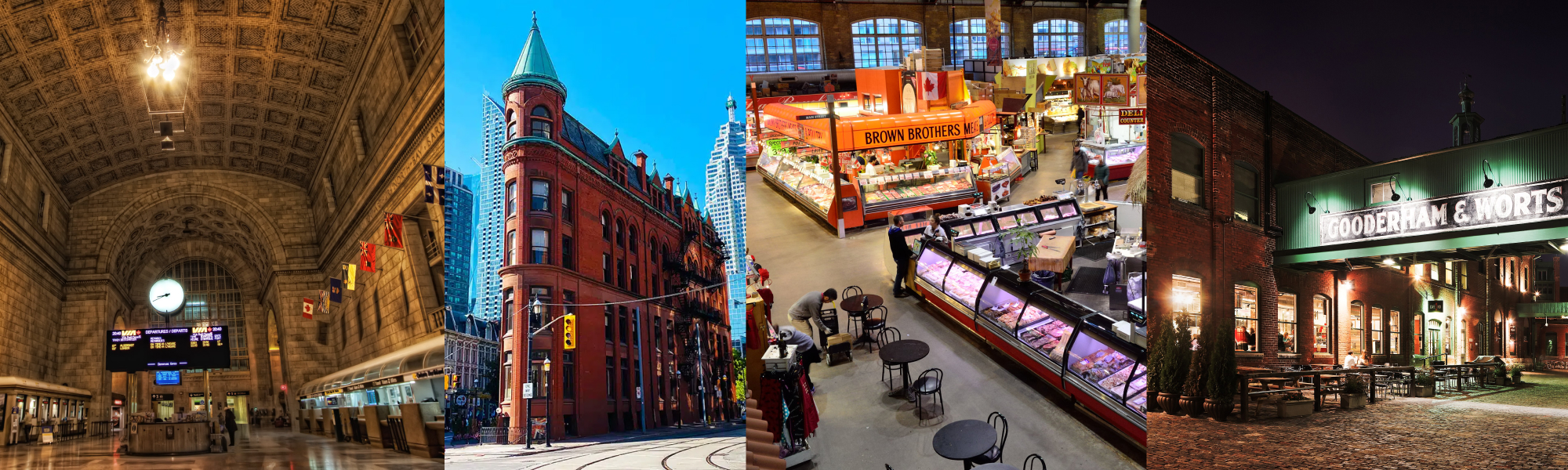
- Union Station + Front Street represents the city’s 19th century industrial roots with a grand train station, a luxury Chateau-esque hotel, a bustling historic food market, and a Victorian distillery complex turned entertainment district.
- Downtown Toronto is the heart of commerce in the city, with office towers, a massive urban mall, a bustling neon-lit square, and an sprawling underground network of pedestrian walkways under its imposing skyscrapers.
- The Grange + Queen Street is a cross-section of Toronto’s everyday artistic, Bohemian, and contemporary moods, where street art coexists with eminent art galleries, upscale food halls complete with Chinatown holes-in-the-wall, and quiet streets with vintage shops flow onto the bustling Queen Street with its cocktail bars and music venues.
- The University of Toronto + Queen’s Park has ornate Old World architecture, quiet parks and pathways, grand museums, and luxury shopping.
Highlights outside downtown Toronto (e.g., Casa Loma, Tommy Thompson Park, and Niagara Falls, are listed in the Other & Farther section at the end.
Questions? Please contact Velian Pandeliev (EduCHI 2026 Local Chair) at [email protected]
NB: All suggestions on this page are unsponsored, subjective, and unofficial.
Harbourfront
Contemporary Tourist Must-See (major city landmarks, baseball, and waterfront walks)
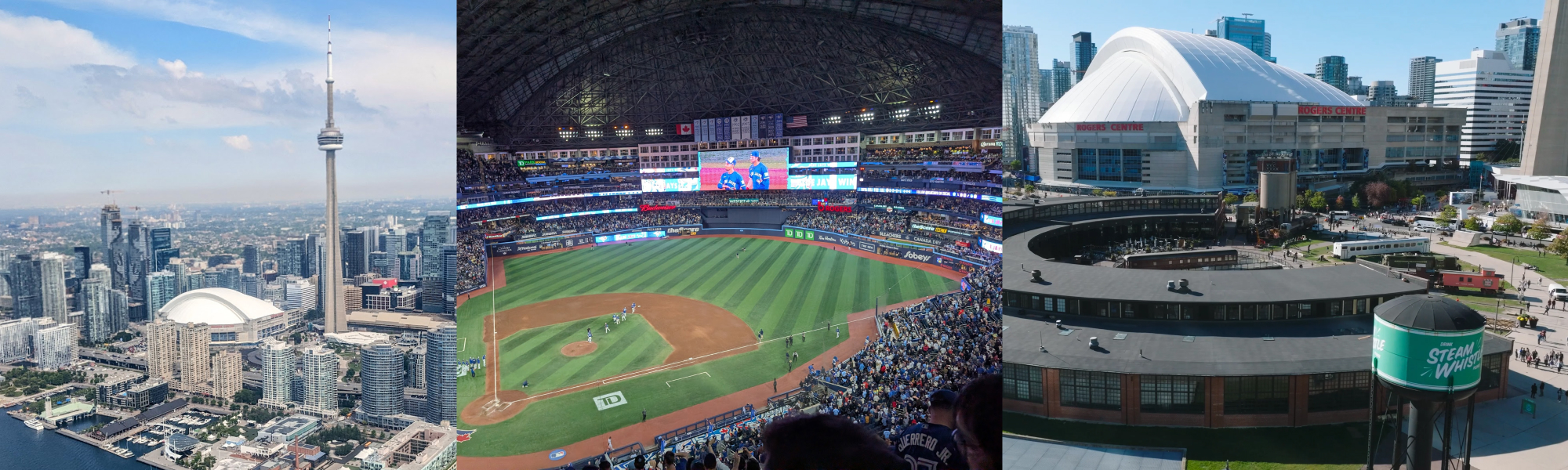
The CN Tower, erected in 1976 by the Canadian National Railway Company to a height of 553.3 m, is the dominant landmark of the Toronto skyline and the tallest free-standing structure in the Western hemisphere. A panoramic viewing platform, a revolving restaurant, and the outdoor tethered EdgeWalk attraction at ~360 m are accessible by glass-floor elevators.
The Rogers Centre (known to locals as the SkyDome) is the home stadium of the Toronto Blue Jays baseball team, known for the domed silhouette of its characteristic retractable roof. Fresh from their 2025 American League Championship win and World Series run, the Blue Jays are in their 50th season, and they’re hosting the Pittsburgh Pirates at the Rogers Centre on May 22, 23, and 24, 2026.
Other attractions:
- Roundhouse Park, the only railway roundhouse left in Toronto, houses the Toronto Railway Museum and the Steam Whistle Brewing taproom.
- Ripley’s Aquarium of Canada is home to some 450 marine species and includes a glass walking tunnel under their Dangerous Lagoon exhibit.
- Queen’s Quay houses the Ontario Science Centre, the Power Plant Contemporary Art Gallery, tall ships, water taxis, and a walking trail with views of Lake Ontario and the Toronto Islands.
Union – Distillery
19th Century Industrial (grand buildings, historical indoor market, Victorian factory neighbourhood)
Start: Take the Line 1 Subway to Union Station
Union Station is the city’s main railway hub with local (TTC streetcars and subways), regional (GO Transit) and national (VIA Rail) connections. Built in 1927, the station recently underwent a major renovation, adding a massive shopping and dining concourse under its cavernous Beaux-Arts Great Hall.
Across from Union Station, the Fairmont Royal York is the largest of Canada’s grand railway hotels, completed in 1929 and boasting a Chateauesque architectural style, an ornately decorated lobby, and the warmly appointed Library Bar.
Walking East along Front Street from Union Station, you will reach:
- The Hockey Hall of Fame is a museum dedicated to the history of hockey, its best players, and its most prestigeous trophy: the Stanley Cup.
- The Gooderham Building’s unique flatiron shape has anchored the acute corner of Front and Wellington Streets since 1892.
- St Lawrence Market is a massive historical indoor market with dozens of food vendors offering fresh produce, seafood, charcuiterie, cheese, baked goods, and Canadian classics such as peameal bacon sandwiches, maple syrup candies, and poutine.
The Distillery District is a historical neighbourhood of 40+ dating back to the 1830s on the grounds of the former Gooderham and Worts Distillery. It is a vibrant entertainment district with numerous galleries, theatre venues, restaurants, and shops, located a ~30 min walk away from Union Station.
Downtown
Urban centre, commercial skyscrapers, indoor and underground shopping
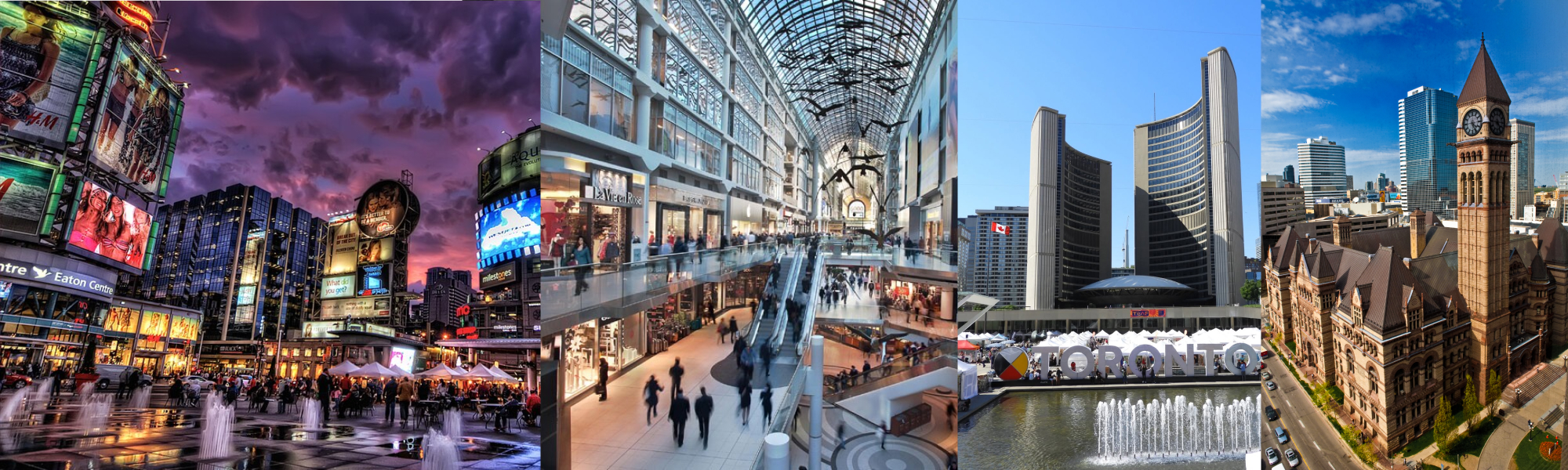
The Eaton Centre is a sprawling indoor mall with an imposing glass roof spanning an entire city block from Dundas St. to Queen St., anchoring the city’s commercial centre. On Dundas St. it opens to Sankofa Square (formerly Yonge-Dundas Square), a busy intersection illuminated by massive video billboards. On Queen St. it neighbours Toronto’s former and current city hall buildings: the Romanesque Old City Hall from the 1890s and the Neo-Expressionist Modern complex at Nathan Phillips Square.
Toronto’s PATH network is considered the largest indoor shopping complex in the world: it is a 30-km network of underground pedestrian walkways that runs under most of downtown, connects 70+ buildings and hosts over 1200 retail spaces.
Grange Park / Queen Street
Contemporary, hip, artistic (modern architecture, Canadian art, local shops and restaurants)
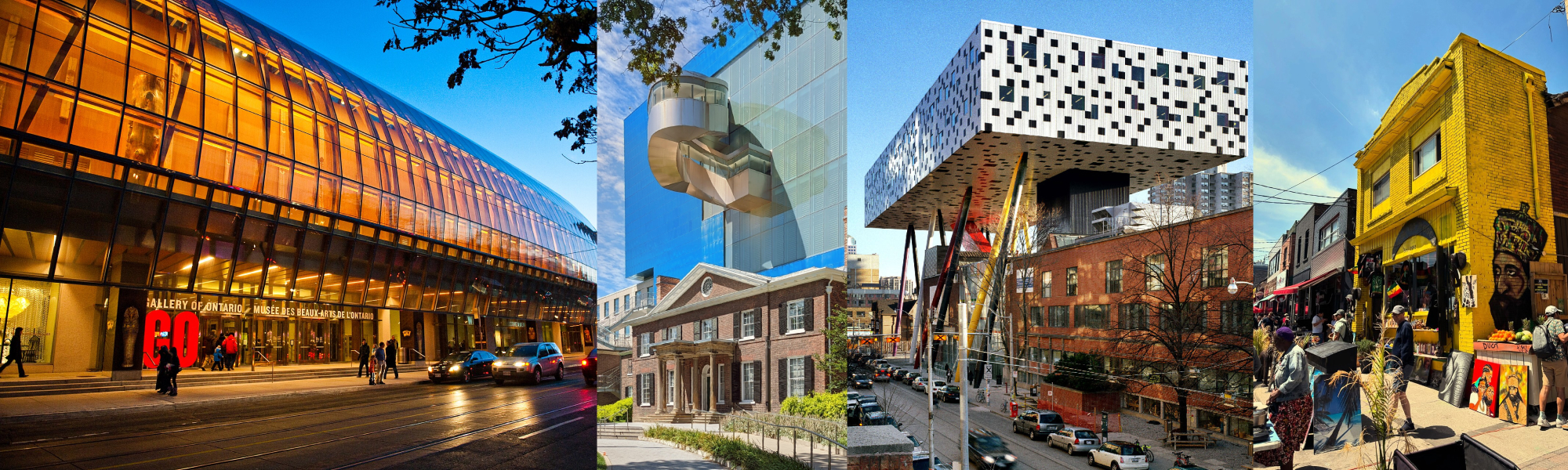
The Art Gallery of Ontario (AGO) houses an extensive collection of Canadian, First Nations, and world art, both historical and contemporary, including works by Canada’s Group of Seven landscape artists, one of Yayoi Kusama’s Infinity Mirrored Rooms, and a collection of model ships. It is known for its iconic curved glass facade designed by Canadian-American architect Frank Gehry.
Grange Park, immediately south of the AGO, contains a range of architectural highlights including the historical Grange Manor (b. 1817, now part of the AGO complex), the surviving belltower of St. George the Martyr Church (b. 1844, destroyed by a fire in 1955) and OCAD University’s Sharp Centre for Design (b. 2004, arch. Will Alsop), colloquially known as the Tabletop, the Pencil Box, or the Pixel Cow.
Continue on Queen Street:
- Try vegan sushi at PLANTA at Queen and University or non-vegan sushi at To-Ne Sushi at Queen and Spadina.
- See Graffiti Alley, officially Rush Lane, for elaborate street art murals
- DROM Taberna is a bar and music venue favouring Eastern European and Romani offerings
- The Waterworks Food Hall is a former water administration building and a great place to sample different foods from local spots such as Harry’s Charbroiled, Boxcar Social, Otto’s Berlin Döner, and Aburi Sushi.
Continue in Chinatown (Dundas / Spadina Ave):
- Check out Sonic Boom’s sprawling assortment of vinyl records
- Pick up a board game at Meeplemart or a vintage video game at A&C Games
- Grab a bite at Mother’s Dumplings, Mashion Bakery, or Buddha Vegan Restaurant
Continue to Kensington Market (Kensington Ave / Augusta Ave / Baldwin St):
- Cafés (e.g., Pamenar, Jimmy’s Coffee, Moonbean)
- Food (e.g., Sunnys Chinese, Otto’s Berlin Döner, koi Japan sushi)
- Grocers (e.g., Blackbird Baking Company, Sanagan’s Meat Locker, Essence of Life)
- Independent shops (e.g., Courage My Love, Tom’s Place, Yarns Untangled)
University of Toronto / Queen’s Park
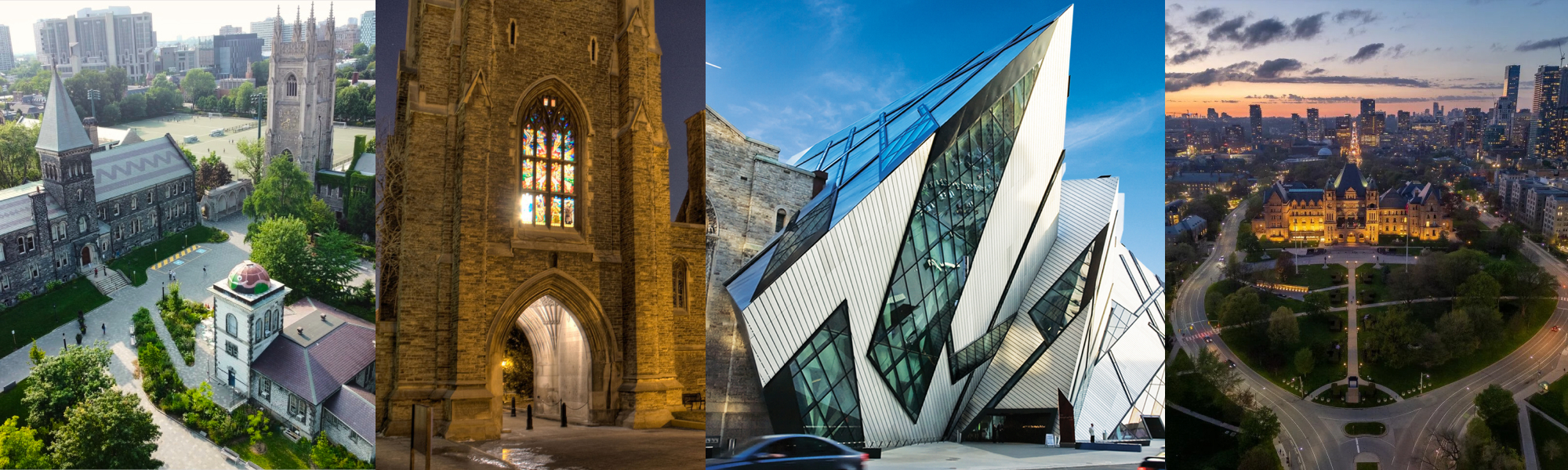
St. George Campus of the University of Toronto is an atmospheric neighbourhood in its own right, with most of its historic buildings concentrated around the Front Campus Quad (Convocation Hall, Knox College, University College) and continuing North past Hart House, Soldier’s Tower, Trinity College, to Philosopher’s Walk. Hart House is the student commons building, and it’s most likely to have open cafes and access throughout the day. Follow Hoskin Ave. West to Robarts Library, UofT’s best-known brutalist building.
Queen’s Park is an oval urban park that begins directly North of our conference venue at the Data Science Institute and encompasses the Legislative Assembly of Ontario building, a 1919 equestrian statue of King Edward VII, and pedestrian and bike trails connecting to the university campus, the Yorkville shopping district, and the Royal Ontario Museum.
Attractions around Queen’s Park:
- The Royal Ontario Museum is a museum of art and natural history known for its dinosaur gallery, rotating exhibits, and its futuristic crystal facade at Bloor Street West.
- The Bata Shoe Museum is a unique museum dedicated exclusively to the history of footwear
- The Writers Room rooftop bar at the Park Hyatt Hotel has some of the best panoramic views of the city.
- Yorkville is a high-end shopping district spanning Bloor St., Cumberland St. and Yorkville Ave. between Avenue Rd and Bay St.
Other and Farther
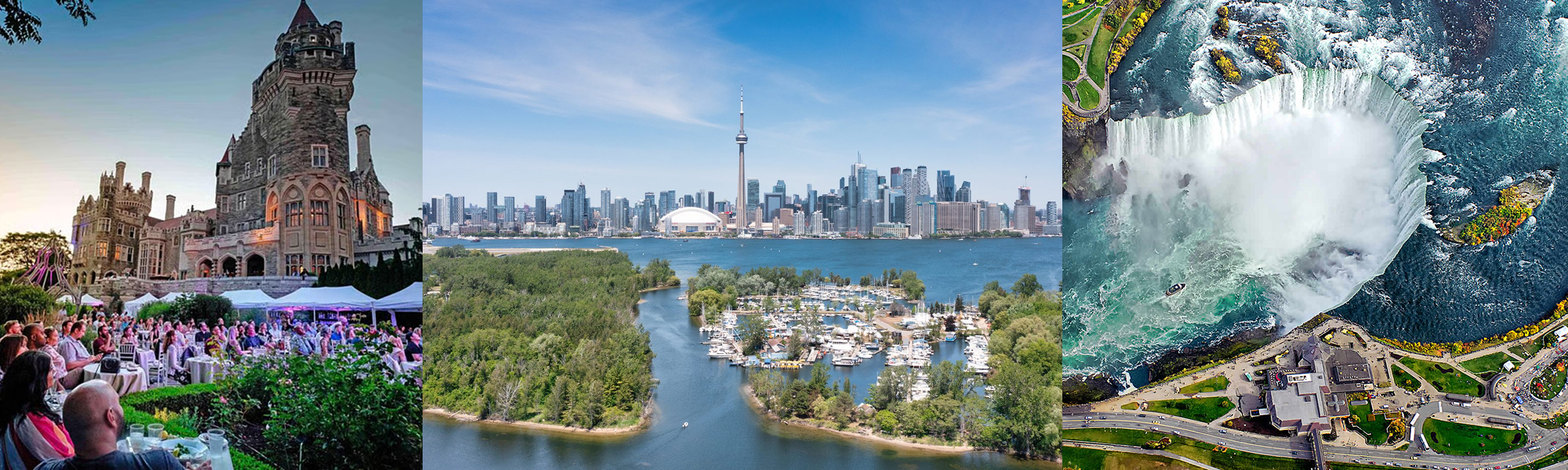
- Casa Loma: built in 1914 as an industrialist’s fanciful Gothic Revival mansion on a hill, now a museum / restaurant / highly themed escape room venue. Look for the Spadina Museum, the Baldwin Street Steps, Tollkeeper’s Cottage Museum, and Wychwood Barns nearby.
- Toronto Islands: a great day-trip to a car-free island complex with restaurants, trails, bike and paddleboat rentals. Take a ferry from the Jack Layton Ferry terminal to Centre Island.
- The Aga Khan Museum (opened in 2014) is dedicated to Islamic art and objects, intended to spark wonder, curiosity, and understanding of Muslim cultures and their arts.
- Evergreen Brick Works: an old quarry and brick factory converted into a park connecting to Toronto’s best ravine parks: the Don Valley, Crother’s Woods, and the Beltline Trail.
- Summerhill / Moore Park: Walk around a picturesque neighbourhood with a former train station turned liquor store, quiet streets, and beautiful mini-mansions in a variety of architectural styles. Take the Line 1 Subway to Summerhill Station, walk past the Summerhill LCBO (formerly the North Toronto train station), then try Roxborough St, MacLennan Ave., and Inglewood Dr.
- Mount Pleasant Cemetery: Sprawling open-air memorial park great for contemplative walks, imposing monuments, and birdwatching.
- Niagara Falls: Toronto’s closest natural wonder is not terribly close, taking about 2 hours to reach by train or bus. Look for the GO Train regional service from Union Station.